Tuesday, January 17, 2012

Burning Magnesium

Materials:
  • Ring Stand
  • Crucible
  • Clay Ring
  • Bunsen Burner
  • Magnesium
  • Scale
Safety:
  • Wear Safety Goggles so the burning magnesium won't blow into your eyes
  • Use tongs to hold on to magnesium
  •  DO NOT LOOK AT THE BURNING LIGHT. IT HAS ULTRAVIOLET RAYS THAT COULD PERMANENTLY DAMAGE YOUR EYES.
Procedure:
  • First locate all of the materials needed for the lab
  • Next, weigh the crucible and write down its weight
  • Then grab several strips of magnesium and weigh them.Try to keep mass of total magnesium over .1g and less than .3g
  • Now you're going to wad up the magnesium and put it in the crucible.
  • The next thing is to turn on the bunsen burner so that the flame is barely touching the bottom of the crucible.
  • Now you have to wait for the magnesium to catch fire. If after two minutes or so it hasn't caught fire, take one strip of magnesium out and put it right in the flame. Without looking at the now burning spark of death, try to use your peripheral vision to put it back into the crucible.
  • Finally once it has finished burning, you will mass the crucible with the contents inside.
  • The last thing is to add distilled water to the crucible and stir and see if it conducts electricity by putting a circuit with lights on it and connect it to the batteries.
  • If the light turns on then you know the magnesium conducts electricity.
Results:
We concluded that the mass of the magnesium after it had burned, increased by .05g. We also found out that after we added the distilled water to the crucible and mixed it, the substance containing magnesium did conduct electricity through the circuit and the light turned on. This means that magnesium itself is a good conductor of electricity and can be used in many appliances.

Questions:
  1. Magnesium Before-.17g                   Magnesium After-.22g                    Increase-.05g
  2. Kinetic Energy was released by the product because it gave off heat and light
  3. We know the magnesium reacts with the air because it started to burn pure magnesium and gave off a bright light
  4. MgO; Mg3N2
  5. The compound that makes up most of the products of MgO and Mg3N2 is mostly nitrogen and oxygen because it gives off different colors of light.
  6. The magnesium did conduct electricity. The results did tell that the compounds were ionic because there was one metal and one nonmetal and it conducted electricity.
  7. I think that if the magnesium would've lost mass is if not all the magnesium burned and left some ribbons in the bottom along with some burned pieces.
  8. Magnesium helps maintain normal muscle and nerve function, helps maintain a steady heart rhythm, supports a healthy immune stystem, and keeps bones strong. About 50% of total body magnesium is found in the bones.
  9. Mg(OH)2 is used as a medicine for relief of heartburn and sore stomach. It is commonly called an over-the-counter drug called magnesium hydroxide.

Magnesium Lab

Materials-
  • Bunsen burner
  • Crucible
  • Ring stand
  • Clay triangle
  • Magnesium ribbons
  • Battery and cables
  • Short string of Christmas lights

Safety Precautions

  • Always have your goggles on.
  • When the magnesium has ignited DO NOT look directly at the magnesium. It gives off damaging UV rays that can damage you eyes.
  • Use tongs when igniting magnesium or moving a hot crucible.

Procedure

  1. Once you have all of your materials gathered fin the mass of your crucible and record it on your data table.
  2. Take your magnesium and place one strip at a time onto a scale until it registers a number. Record the number.
  3. Crumble the magnesium into a loose ball then place it in the crucible and then place the lid on top of the crucible.
  4. Put the crucible on the clay triangle and place it on the ring stand that is over the bunsen burner.
  5. Turn on the bunsen burner so that it is heating the crucible with the magnesium.
  6. Let it sit with the lid on for a few minutes.
  7. If the magnesium does not ignite take the lid off and wait for a few minutes.
  8. If it still has not ignited take out a strip of magnesium, hold it in the flame for a few moments until it ignites. Use your peripheral vision to observe the magnesium, DON'T look directly at it. Then place the strip back into the crucible.
  9. Weigh the remaining magnesium ( weigh the magnesium and the crucible and subtract the weight of the crucible) and record it in your data table.
  10. Then fill the crucible with water and connect the battery to the cables and the Christmas lights. If the Christmas lights give off a glow, you know that magnesium conducts electricity.
Question

  1. Before= .1g of magnesium After= .4g Difference= gained .3g
  2. Thermal energy was given off when the magnesium ignited and so was light. This means that a chemical reaction occurred, so we can assume that a new product was formed.
  3. We know that the magnesium reacted with the air because it increased by .3g so it had to bond with other elements in the air because that made the mass increase.
  4. Mg3 N2 Mg O
  5. Magnesium Oxide, from looking at the ashes the majority of our product was white.
  6. The magnesium compound did conduct an electric current. We know that it is ionic because It is between a metal (magnesium) and a nonmetal (oxygen/nitrogen). Also, this is just a guess, but ionic compounds make positive and negative ions, would that have anything to do with electricity flowing from one charge to the next?
  7. An error could be that the person doing the experiment could have not massed the crucible or the magnesium correctly at the beginning or the end of the lab.
  8. Yes
  9. Milk of Magnesia

Burning Magnesium Morgan Vanderpool


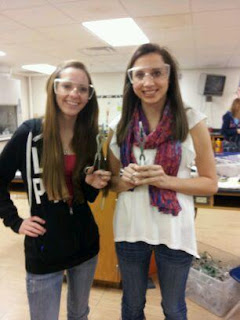
The first picture is a picture of just crucible without the magnesium inside. The mass is 23.02. The second picture is a picture of the set up after the magnesium is added to the crucible and the Bunsen burner is underneath the tripod heating the crucible. The third picture is a picture of the the magnesium added to the crucible its mass is 23.19. The fourth picture is a picture of some materials you will need during the burning of the magnesium. The fifth picture is a picture of tongs that you will use in case the magnesium does not lit fire. You will use the tongs to lift the lid off of the crucible and pick up the magnesium to put the magnesium under the fire to light it. If it lights then look out of the corner of your eye to put the magnesium back into the crucible because the light is very bright and could hurt your eyes. Speaking of your eyes showing you in the second to the last picture make sure to have your safety eye glasses on at all times. Also in the picture is a hair tie so if you have long hair you need to put it up. In the last picture is of the magnesium all burned up in the crucible weighing 23.18
Questions:
  1. Mass of magnesium before was 23.02g and after the magnesium was burned its mass was 23.19g. The difference between before and after was .17g.

  2. The Kinetic energy was released by the product because it gave off heat and light.
  3. The Magnesium reacts with certain air components because when the magnesium was lit fire the oxygen was lit also making the magnesium react with the little amount of oxygen.
  4. Magnesium Oxide , Magnesium3 Nitride2.
  5. After the magnesium was completely burned all that was left was white leaving the product formed from oxygen and magnesium.
  6. Yes, there was an electric current that conducted with the magnesium compounds. No, nothing showed that the compounds were ion
  7. Its the incorrect measurement, or you didn't let the magnesium completely melt.
  8. Magnesium is the fourth most abundant mineral in the body and makes up 50% of the bodies bones and cells. Magnesium is very important for your physical and mental health and can be listed in many different types of vitamins and minerals.
  9. Magnesium hydroxide or milk of magnesium.


Lab Write Up

Materials: You will need...


  1. Magnesium strips


  2. A crucible


  3. A ring stand


  4. A bunsen burner


  5. Some distilled water


  6. A scale


  7. A clay triangle


  8. Batteries


  9. Cables


  10. Short string of christmas lights


Warnings:
  1. Do not lick the battery!
  2. Don't look at the burning magnesium when on fire. It produces UV rays that can damage your eyes.
Procedure:
  1. Find all of your equiptment and make sure it it clean and useable.
  2. Mass your magnesium strips in the crucible until the number of the mass goes up from the empty crucible.
  3. Roll the strips you massed into a ball and place it in your crucible,which should be on your clay triangle on a ring stand over a bunsen burner.
  4. Turn on your bunsen burner and light it, make sure your flame isn't too high.
  5. Let your magnesium sit in your crucible with the lid on for a few minutes. If it doesn't light take the lid off and let it sit. If it still doesn't light you have to pick up your magnesium with tongs and manually light it by puting it in the fire. As soon as it's lit carefully and quickly put it back in the crucible and wait until its done burning.
  6. Mass your crucible again and record this mass.
  7. Repeat this process from step two
  8. Now mix in a little distilled water into the crucible.
  9. Connect the cables to the battery and lights. See how the lights light up if its set up right?
  10. Now take the cables and out them in the magnesium water. If done right the lights should flicker
  11. Now carefully clean up your stations

Book Questions:

  1. .17 g to .22 g
  2. This lab produced thermal energy because it lit up when on fire.
  3. We know because it flickered and didn't really light until lit in the fire.
  4. MgO and Mg5N2
  5. Oxygen, because when it was done burning it had a more white product
  6. Yes, and bothe combinations were metal + non-metal
  7. if the producy masses less then maybe you massed wrong

Friday, January 13, 2012

Burning magnessium lab

In this lab we learned how to make magnessium burn. First we had to put goggoles on. Next we had to get all the materials put together.

We then set up the tripod and put a glass beaker on it and then we put the burning magnesium and didnt look at it and put it in the beaker.

Magnesium Lab

Safety: you will need to wear goggles make sure long hair is tied back and when the Magnesium lights make sure not to look directly at it.
Materials needed: you need a ring stand, one gram of magnesium, a Bunsen burner, and some batteries and wire.
Procedure the first thing you need to do is find a crucible and weight it using a scale Setup a ring stand over a Bunsen burner and place clay triangle on the stand and Attach the Bunsen burner to gas Do Not turn the Gas on yet. Find and weight magnesium ribbon Place ribbon in crucible Turn gas on and light the Bunsen burner Adjust heat so the tip of the flame barely touches the bottom of the crucible you should have a blue flame then let it heat for 2-3 minutes. Wait for magnesium to burn out Weigh the crucible after it has cooled off and compare with beginning weight plus the weight of the ribbon mix the water and magnesium and stir Take a light strip and strip the ends and connect them to clamps and place them in the mixture Take the other ends and hook them to batteries and see if a light goes on inside one of the lights When cleaning out crucible dump mixture in TRASH and wipe out carefully with a paper towel.
Results For my results I noticed that the crucible was the same after igniting the magnesium as it was before if you would add the weight of the crucible and the ribbon.

Magnesium Lab

Safety:


Materials:

Ring Stand
Bunsen Burner
Crucible
Stirring Rod
Balance
Distilled Water
Tongs
Clay Triangle
Striker

Procedure:
  1. Place the ring on the ring stand 7 centimeters above the bunsen burner.
  2. Put the clay triangle on the ring.
  3. Roll about 25 centimeters of the magnesium ribbon into a loose ball.
  4. Measure the mass of the crucible and magnesium.
  5. Place the magnesium in the crucible.
  6. Turn on the bunsen burner so that the flame is slightly touching the bottom of the crucible.
  7. After two minutes, take the magnesium out of the crucible and put it directly into the flame.
  8. The magnesium shines a bright light that you cannot look directly into. Use your peripheral vision to place it back into the crucible.
  9. After the magnesium burns, measure the mass again.
  10. Add distilled water to the crucible.
  11. Stir the mixture.
  12. See if it conducts energy by putting a type of circuit that has lights on it and connect it to the batteries.
  13. The magnesium conducts energy if the light turns on.

Results:
After adding the distilled water, the mass increased about .05 grams. The circuit light turned on, which means the magnesium did conduct electricity. This proves that it is a good conductor and can be used in appliances.

Questions:
  1. Magnesium Before: .18g After: .23g
  2. Kinetic energy was released because it gave off heat and light.
  3. Magnesium reacts with air because it burned and gave off a bright light.
  4. MgO. Mg3N2.
  5. Nitrogen and Oxygen is a compound because it shows different colors of light.
  6. It conducted electricity. It showed that it is ionic because there was one metal and one nonmetal.
  7. I think the magnesium could lose mass if it wasn't all burned.
  8. Magnesium helps maintain normal muscle and nerve function, a steady heart rhythm, supports a healthy immune system, and keeps bones strong. About 50% of body magnesium is found in bones.
  9. Mg(OH)2 is a medicine used for heartburn relief and a sore stomach called Magnesium Hydroxide.